
Last updated on 08/09/2026
On this page
Living in Chile is less about Patagonia, Atacama, and vineyards than the practical details: what daily life costs, how safe it feels, and how to get set up in a country with reliable infrastructure and plenty of paperwork. This section covers those details for expats planning a move or already living here.
What is it like to live in Chile?
Chile has one of the region's higher standards of living, with reliable infrastructure, modern healthcare, drinkable tap water, and fast internet. Daily life is generally calm and family-centered. It is also more reserved and formal than in neighboring countries, and Chilean Spanish can challenge even fluent speakers. You also need to account for earthquakes, Santiago's winter smog, and local salaries that can feel low beside the cost of imported goods. Start with our guide to the climate in Chile to compare regions, then read the pros and cons of living in Chile.
Is Chile a good country to live in?
For many expats, yes. Chile ranks near the top of the region for quality of life, safety, and ease of doing business. It tends to suit people who value stability and access to nature. It is less suitable if you expect very low living costs, active nightlife everywhere, or quick bureaucracy. Your income source, tolerance for paperwork, and choice of city usually decide whether it works for you. Compare options in our where to live in Chile guide or read about the capital in living in Santiago.
How much money do you need monthly to live in Chile?
As a rough 2026 guide, a single person living comfortably in Santiago typically budgets USD 1,500-2,200 per month including rent. A couple may spend USD 2,500-3,000, while a family paying private school fees needs considerably more. Chile is among South America's more expensive countries, although a comparable budget can still be 30-40% below major US cities. Full numbers for rent by neighborhood, groceries, utilities, and healthcare are in our cost of living in Chile guide, and you can compare them with local pay in average salary in Chile.
Is Chile safe?
Chile remains among the safest countries in Latin America, though crime has risen since 2019 and conditions differ from Europe. Violent crime against foreigners is rare, while pickpocketing and phone snatching in Santiago are common enough to plan for. We cover the data and neighborhood differences in is Chile safe?. Also read about natural risks—earthquakes are part of life here—and Santiago's winter pollution.
Settling-in practicalities
These guides cover the practical setup:
- RUT and RUN: the Chilean ID numbers you need for everything, from contracts to online shopping
- Chilean customs and etiquette: tipping, greetings, addresses, and how not to stand out
- Internet providers: fiber is cheap and fast, plus how to choose and set up
- Mobile phones: operators, plans, prepaid options, and IMEI registration if you bring a phone from abroad
- Phone and emergency numbers: the numbers to memorize
- Online shopping and Amazon in Chile: what delivers here and what doesn't
- Education in Chile: how the school system works, plus our guide to international schools in Santiago
Chile at a glance
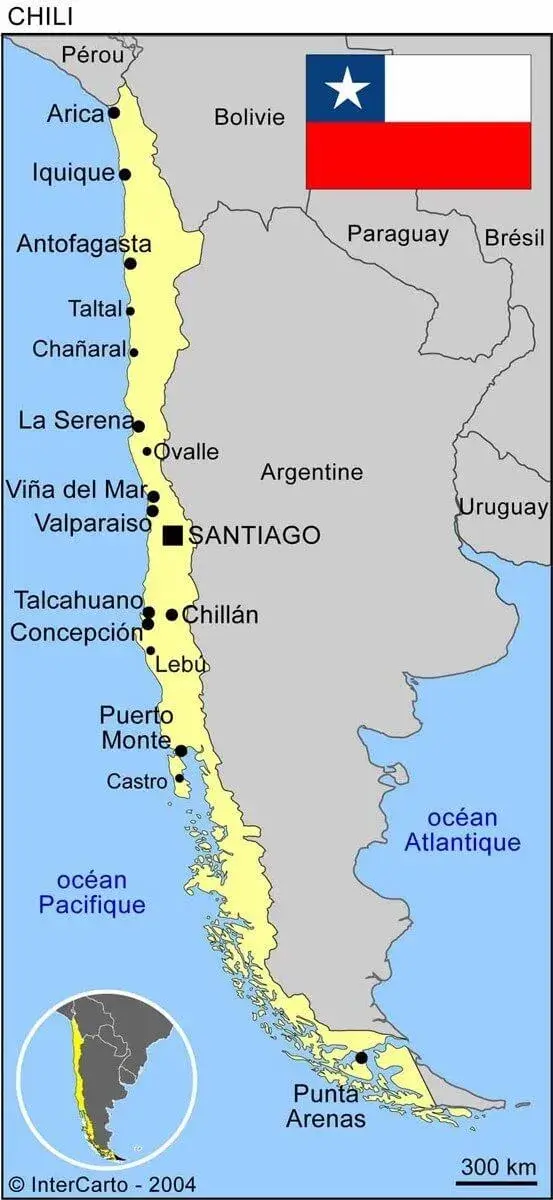
Almost 4,300 kilometers long and only 400 kilometers at its widest point, Chile is a thin line along the Pacific coast, bordering Argentina, Bolivia and Peru. It has about 19.5 million people (2024), 87% of them in cities, and is divided into 16 regions, themselves split into provinces and comunas. Santiago, the capital, holds over 7 million people in its metropolitan area. The geography runs from the Atacama Desert to subpolar Patagonia, and our climate in Chile guide breaks it down region by region.
Chile has one of Latin America's more stable economies and one of the region's higher GDP per capita figures. Besides copper, it exports salmon, fruit, and wine; it is the world's fourth-largest wine exporter, and some vineyards are older than many European ones. The currency is the Chilean peso (CLP).
Society remains marked by the Catholic Church: about 70% of Chileans are Catholic, and the Church's influence shows in the law (divorce only became legal in 2004, same-sex marriage in 2022). Football is the national passion, celebrated loudest when La Roja wins, and the national table is worth discovering through our guide to Chilean food.
Retiring in Chile
Retirees often consider Chile for its climate, healthcare, and stability. Our retire to Chile guide covers income requirements, healthcare choices, and where retirees settle. The retirement visa guide covers the immigration process.
Help with your setup
If you want practical help, our settling-in package covers the RUT, bank account, SIM, and utilities before you land. Our expat support membership provides ongoing help once you are here. You can also book a consultation to discuss your move.
Keep reading

Life in Chile
Retire in Chile: The Complete Guide for US Citizens (2026)
Life in Chile
Retire in Chile vs Portugal, Uruguay & Panama (2026)

Life in Chile
Chilean food

Life in Chile
Climate in Chile

Life in Chile
Amazon in Chile: Online Shopping Guide for Expats

Life in Chile
Average Salary Chile 2026: Wages, Minimum Wage, Take-Home