Last updated on 03/09/2026
On this page
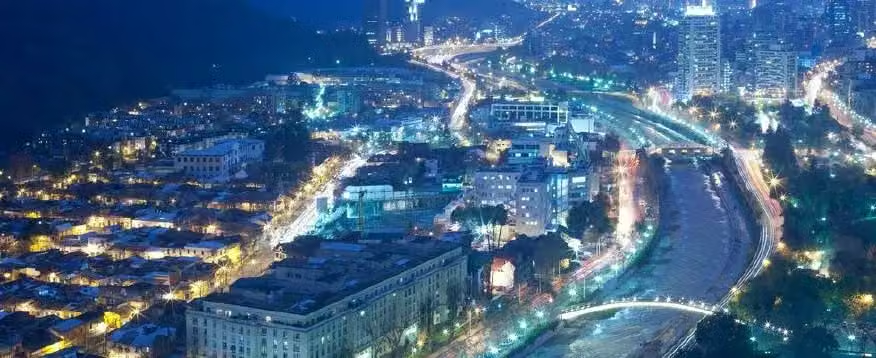
The Chilean capital, in the center of the country, has almost 6 million people, or a third of the total population. Santiago hosts the most foreigners in Chile, so the expat communities are large and active.
Climate in Santiago
If you come from the northern hemisphere, the seasons are reversed: temperatures cool from April and rise from October. Chileans celebrate Christmas in T-shirts and sandals, summer holidays are in January and February, and back-to-school is in March. You may lose your bearings at the beginning.
Santiago has a mild Mediterranean climate. Summer is long (about 5 months), days are hot but nights are cool. As for winter, it is cool without being too cold and it rains very rarely. However, Santiago is fairly polluted in winter (in particular in July / August) because of the city's geographical situation, so that exhaust gas is not swept by the wind.
Cost of living in Santiago
The cost of living in Chile is significantly higher than neighboring countries such as Peru or Bolivia. If you're planning to move to Santiago, you need a substantial budget. For current prices, budgets, and cost comparisons, see our cost of living in Chile guide.
Food
On food, you can find almost all the products you are used to in your home country. However, the Chileans are highly influenced by the American culture, so they consume a lot of prepared dishes and soda. They are gradually becoming aware of the need to eat a balanced diet, and organic products have made their appearance in supermarkets in recent years..
Several supermarket chains exist in Santiago:
- Jumbo: it is the most upscale supermarket chain, offering a large selection of imported products.
- Tottus: it is Jumbo's competitor but a little cheaper. The range of choices is a little more restricted but still very sufficient.
- Santa Isabel: it belongs to the same group as Jumbo and is the more "popular" version of it. You will find fewer imported products.
- Líder: it belongs to the Walmart group and is a relatively basic chain, where you will find essential products if necessary.
For fruits and vegetables, local markets offer better quality than supermarkets most of the time, at a cheaper price.
Accommodation in Santiago
In Santiago, it is fairly easy to find an apartment or a house to rent or buy at reasonable prices. Property prices in Santiago remain lower than major international cities like London, New York, or Paris. For current real estate prices, rental costs, and detailed neighborhood comparisons, see our housing section and cost of living guide.
Our rental guides for the capital:
- Finding an apartment or house in Santiago: the search and signing process from start to finish
- Apartments for rent in Santiago: prices and neighborhoods for apartment hunters
- Houses for rent in Santiago: for families needing more space
- Sharing a flat and finding flatmates: the budget option for students and young professionals
Where to live in Santiago
Santiago is divided into 37 municipalities, but expats typically settle in six or seven of them. Each has its own character, price range, and trade-offs. Here is a quick orientation:
Santiago Centro is the historic heart of the city: cheap, close to universities, with many modern towers south of the Alameda. Good for students and young professionals on a budget. Not great if you need a car or want peace and quiet at night.
Providencia is the most popular area for expats. It has direct metro access, a cosmopolitan feel, good restaurants, and it is safe to walk around at night. Buildings are small (seven floors max), which keeps the neighborhood attractive but means higher condo fees. Bellavista, on the northern edge, is lively for going out but not ideal for living, too noisy.
Ñuñoa is similar to Providencia but cheaper and more residential. The Barrio Italia area has developed into a cultural hub with cafés, galleries, and restaurants. Good for young professionals who want more space without the Las Condes price tag.
Las Condes is the largest wealthy municipality. El Golf / Alcántara is the business district ("Sanhattan"), with Escuela Militar just east of it. Manquehue / Parque Araucano is great for families: modern buildings, a big park, close to metro and international schools. It is safe and well-equipped but spread out.
Vitacura is one of the wealthiest areas, popular with affluent expats and families with children at the French school or Bradford School. Beautiful, quiet, with good restaurants and the Parque Bicentenario. No metro: you need a car, and getting to the city center takes 45+ minutes during rush hour.
Lo Barnechea is the most northerly and exclusive municipality. La Dehesa is where you find luxury houses, gated communities, and proximity to the best international schools (Nido de Aguilas, Santiago College, Craighouse, Lincoln). Suburban, family-oriented, and expensive. Car essential.
Colina, technically outside Greater Santiago, is where the newest gated communities are: Chamisero and Chicureo attract families chasing space, new construction, and the second campuses of several international schools. The trade-off is the commute.
Each neighborhood name above links to a detailed guide with street-level recommendations. Considering life outside the capital? See our guide on where to live in Chile.
Public transport in Santiago
Santiago's public transport network (bus and metro) is fairly dense and efficient. However, be aware that the metro is often crowded. For the bus, it is better to know the city before using this means of transport or have a map of the city with you because the stops served are often not indicated. It is therefore difficult to find your way around.
Also, be sure to keep an eye on your belongings in public transport, as these are subject to numerous thefts. You should always keep your bag closed, in front of you or on your lap. On public transport in Santiago, see this guide.
Driving in Santiago is fairly aggressive and not always faster than public transport.
Safety in Santiago
Chile is among the safest countries in Latin America, with one of the lowest crime rates in the region. However, as in all countries, there are some safety rules to respect. First, watch your belongings because thefts are frequent, especially in public transport and tourist areas. If you have a car, do not drive with the windows completely down, be it on the passenger or driver side, because pickpockets are very quick and can steal your stuff in seconds.
For a neighborhood-by-neighborhood breakdown, including the areas to avoid and how safety has evolved since 2019, see our guide: is Santiago safe?
Come to Chile with your children
Except for the air pollution in winter (in July / August), Santiago is an ideal city to raise children, all the more so as the safety level is high. For family outings, Santiago has many green spaces, not just small squares but big parks such as the Cerro Santa Lucía, a hill in the middle of the city that offers a wonderful view of Santiago, or the Parque Metropolitano.
On the education system, the Chilean academic pace is peculiar. Each school has more or less its own rhythm. As for the school calendar, back-to-school season takes place in March, and the year ends in December. If you move from the northern hemisphere, your children will probably have to spend a few months in the year they already were in their home country. Only the Nido de Aguilas school follows the school year of the northern hemisphere. Our guide to international schools in Santiago reviews 15 schools with fees, admission processes, and honest assessments.
Every school offers a bus system that consists of picking up your children at home in the morning and bringing them back at the end of the day. This service is well developed and works very well.
Having a "nana", meaning a maid, is a widespread practice in Santiago. The nana can live at home or come one or several days a week. She can help you a lot at home: babysitting, going out to the park with the children, cleaning, ironing, and cooking. It all depends on the working time and the salary granted. To avoid any legal complication, you should declare your nana. Word of mouth is often the best way to find a good nana.
Leisure / sport
Santiago is less than an hour from both the Pacific Ocean and the mountains, so day trips or weekends are very easy to organize. During the winter season, it will only take you 45 minutes from the center of Santiago to reach the first ski resorts: El Colorado is the closest station and Valle Nevado is the largest ski area in the southern hemisphere.
If you are fond of hiking, the Andes Mountains offer a lot of trails, for all levels. However, be aware that there is no IGN map, so you will have to do with a GPS or maps provided at the entrance of the national parks.
In Santiago, most multi-sports clubs are private. To access it, the easiest way is to know a member who can then invite you. Membership fees vary but can be very high in the most select clubs. If you have a smaller budget, you can consult the website of your municipality. Most of them organize sport activities on a weekly basis, at a reduced rate for their residents.
Santiago is a cultural city, with museums like the Pre-Columbian Art museum, the Natural History museum, and La Chascona, which was the house of the poet Pablo Neruda.
Find a job / do business in Santiago
Santiago is a growing city which has changed a lot in the last ten years. It was named first city in Latin America to do business. So you can find work or start your business without much difficulty.
However:
- if you are looking for work and you are not qualified, or your profile is not in line with what companies are looking for, it will be difficult to have a decent salary.
- if you do not have a visa, very few companies will wait for you to go through the procedure. It is therefore necessary to initiate all the steps from your home country, before coming.
Relationship with Chileans
Chileans are very welcoming and most foreigners are well received. However, in the long run, it appears that the society is fairly homogeneous and is not used to the contact with other cultures and thoughts, so even though relations between Chileans and foreigners are cordial, it seems that friendship remains very superficial. Chileans mainly build links in their families, which are often very large, and at school when they are young.
Planning your move to Santiago?
We have helped expats and their families settle in Santiago since 2016, from finding the right home to the right school. Book a consultation to talk through your plans.
Frequently asked questions about living in Santiago de Chile
Neighborhood Selection
Which Santiago neighborhoods are best for families with children?
Las Condes (Manquehue area), Vitacura, and Lo Barnechea are top choices for families due to proximity to international schools, parks, and family amenities. Ñuñoa offers a more affordable option with cultural attractions and good school access.
How do I choose between Santiago neighborhoods?
Consider these factors: Budget (Vitacura/Lo Barnechea most expensive, Ñuñoa most affordable), Transportation (Providencia best metro access), Work location (Las Condes for business district), School proximity (varies by school choice), Lifestyle (urban vs. suburban feel).
Where do most expats live in Santiago?
Providencia and Las Condes host the highest concentrations of expatriates. These areas offer good infrastructure, international community presence, metro access, and amenities familiar to Western expats.
What are typical commute times between different areas?
By Metro: Providencia to Las Condes (15-20 min), Santiago Centro to Las Condes (25-30 min). By Car: Vitacura to Santiago Centro (20-45 min depending on traffic), Lo Barnechea to Santiago Centro (30-60 min). Peak hours significantly increase travel times.
What is the nicest neighborhood in Santiago, Chile?
It depends on what "nice" means to you. Vitacura is one of the wealthiest and most beautiful areas, quiet and green around Parque Bicentenario, but it has no metro, so you need a car. Providencia offers the best balance of walkability, metro access, restaurants, and safety, which is why it is the most popular area for expats. Families often prefer Las Condes (Manquehue) or Lo Barnechea for space, parks, and proximity to international schools.
Daily Life
Is it safe to walk around Santiago at night?
Safety varies by neighborhood. Very Safe: Providencia, Vitacura, Las Condes residential areas. Exercise Caution: Santiago Centro after dark, some areas of Ñuñoa. Always watch personal belongings regardless of neighborhood.
What are the main challenges of living in Santiago?
Air pollution (June-September), traffic congestion during peak hours, language barrier (Chilean Spanish is challenging), earthquake preparedness needed, and cultural adjustment to more formal social interactions initially.
How do I deal with Santiago's air pollution?
Consider living in higher altitude areas (Lo Barnechea, Las Condes foothills), use air purifiers indoors during winter, limit outdoor exercise on high-pollution days, and consider spending winter weekends outside Santiago.
How much money do you need to live in Santiago, Chile?
The cost of living in Chile is significantly higher than neighboring countries such as Peru or Bolivia, so you need a substantial budget, although property prices remain lower than in cities like London, New York, or Paris. Your budget depends mostly on the neighborhood: Santiago Centro and Ñuñoa are much more affordable than Vitacura or Lo Barnechea. For current prices and example budgets, see our cost of living in Chile guide.
Is Chile friendly to American expats?
Yes. Chileans are very welcoming and most foreigners are well received, and Santiago hosts the largest and most active expat communities in the country, so Americans find an established network quickly. Be patient with local friendships though: Chilean social life centers on family and old school friends, so relationships with locals can stay superficial for a while.
Keep reading

Living in Santiago
Live in Colina
Living in Santiago
Is Santiago Safe? A Neighborhood-by-Neighborhood Answer
Living in Santiago
Apartments for rent in Santiago
Living in Santiago
Finding an apartment / a house in Santiago
Living in Santiago
Houses for rent in Santiago
Living in Santiago
International Schools in Santiago