Last updated on 03/09/2026
On this page
Banking is one of the first practical hurdles after arriving. Most banks of Chile are conservative with foreigners, and knowing which doors actually open saves months of frustration. This guide covers the major banks in Chile, how to choose one as an expat, online banking, and a check-security warning that can save you real money. It is part of our finance in Chile section.
Chile has several major banks serving private clients. According to recent rankings, the largest by Tier 1 capital are:
- Banco Santander Chile (largest by capital)
- Banco de Chile
- Banco de Credito e Inversiones (BCI)
- BancoEstado (most accessible for expats)
- Banco Itau Chile
- Scotiabank
- BBVA
You can also find a lot of representative offices of international banks, but that's not what interests us now, as they are mostly focused on corporate clients.
Which bank to choose?
In most countries, when you need to choose a bank, you compare their services, the price, and their reputation, and then you choose the one that seems the best fit for your needs.
That's how it should work in theory.
But in Chile, opening a bank account remains challenging for expats. Banks are conservative and typically deny services to foreigners without proof of high income from local companies, usually requiring two years of residency. You'll likely open an account with the first bank that accepts you, which could be your company's bank or through personal connections. Every option starts with the same prerequisite: a RUT number. For the step-by-step procedure, see our guide on opening a bank account in Chile.
To help you choose, here are a few facts:
- BancoEstado is the most accessible option for expats, being the only bank that consistently works with temporary residents. You can open a CuentaRUT online as soon as you get your national ID. It's the public bank and doesn't discriminate by income level.
- Banco BCI has a service called BCI NACE, which is dedicated to new entrepreneurs, who are just starting their company. A few years ago, banks were only willing to open accounts to companies already making money… Now, it's still difficult, but BCI is among the most entrepreneur-friendly.
- Banco ITAU and Banco Santander are focused on affluent people. So if you have a nice steady income or a lot of assets (not necessarily in Chile), you should not have problems. Same thing if you are an entrepreneur with a nice project that has a growth potential. If not, these might not be the best option.
- ScotiaBank offers a "Cuenta Corriente para Extranjeros" specifically for foreigners on temporary visas, requiring proof of monthly income of at least CL$301,000. Despite its name, it doesn't offer credits or checks - technically it's a "cuenta vista."
- Banco BICE offers a current account without a credit line, and is more inclined to open an account if your project is large enough (a few hundred thousand euros).
Very limited opening hours
Like most administrations in Chile, banks are only open from 9 am to 2 pm, Monday to Friday, which explains the queue you can sometimes see at 8:45 am when you walk near a bank. Everyone wants to do operations before going to work.
A few branches can open a little later, or even during the weekend, but that's (very) rare. See your bank's website.
Even if a bank closes at 2 pm (sometimes 15 minutes before), they will serve you if they have allowed you to enter.
Online services
Online banking services are well developed in Chile, with penetration rates reaching nearly 30% by 2023. Your online account allows wire transfers, balance checks, and other banking operations. The interbank wire transfer system provides immediate availability of funds between local banks. However, you generally cannot open accounts online - you must appear in person at a branch with required documentation.
Keep these two things in mind:
- Try to download your bank statements as soon as they are available (especially for company accounts). Indeed, you can download the last 12 statements for free, but they will charge you for older statements.
- Check that your relationship manager has properly registered your email in the system. All wire notifications or confirmation requests are sent by email. But I got the same problem with two banks: none of them registered my mail, and none of their systems generated an error when trying to send an email to an account with no mail registered. So you are stuck without the option to perform a wire transfer, or to check if you have received funds...
Need a RUT from abroad?
The service includes:
- Power of attorney and local representation
- Application filed in Chile
- RUT delivered electronically
Credit cards and daily payments
Getting a Chilean credit card follows the same logic as accounts: banks issue them readily to clients with proven local income, reluctantly to everyone else. Your international cards work fine in the meantime: most stores, restaurants, and online services accept foreign Visa and Mastercard. For how credit cards in Chile work (national vs. international cards, installments or "cuotas", and fees), see our guide on credit and debit cards in Chile. And for moving funds in and out of the country, see money transfers from/to Chile.
Checks in Chile: a security warning
While digital payments are rapidly growing in Chile (with debit cards accounting for 37% of POS transactions and the digital payments market growing by 11.24% annually), checks remain part of the payment ecosystem, particularly for business transactions and larger amounts. If your bank gives you a checkbook, there is a crucial security point that can cost you a lot of money if overlooked.
How to lose money quickly with a check
In Chile, checks:
- can be exchanged for cash at any bank
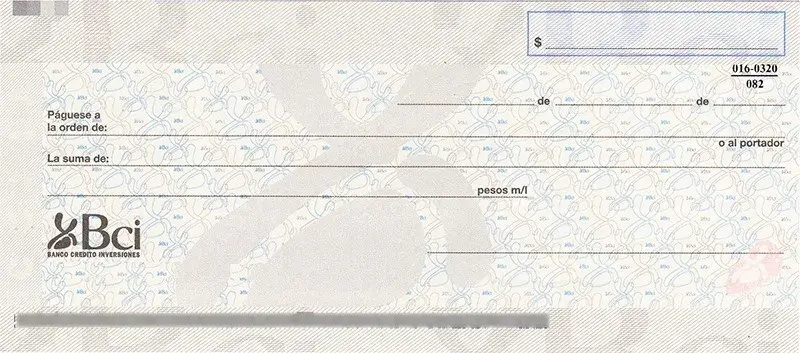
- Have a mention on the right that says al portador, meaning anyone who has the check can cash it.
Conclusion: if you write a check to someone, and it gets stolen, the thief can cash it, and you're screwed.
To avoid this, when you receive a new checkbook, you should:
- Add two diagonal lines on each check: this prevents anyone from cashing it. All checks with diagonal lines will need to be deposited in an account
- Remove the two words al portador: this prevents anyone but the designated beneficiary from using it.
Yes, this is a bit tedious to do… but it's better to be safe.
Here is a regular check (without the name/account number, of course) :
The safe version
Here is the modified and more safe version :
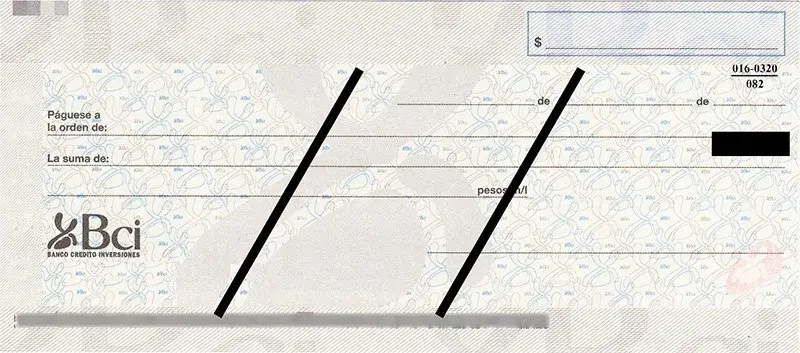
Ideally, this should be done on your entire checkbook as soon as you receive it. Otherwise, it is easy to forget, and when the check is issued, it is too late.
Getting set up
Banking setup in Chile has more moving parts than most expats expect. We know which banks say yes to which profiles and handle the process as part of our relocation packages. For the walkthrough, continue with our guide on opening a bank account in Chile, from CuentaRUT to cuenta corriente.