- Home
- Expat Guide
- Accommodation in Chile
- Finding an apartment / a house in Santiago
Last updated on 19/03/2026
If you decide to stay in Santiago for more than a few weeks or months, you will have to rent an apartment or a house on a long-term contract. Let's have a look at how to do this. If you found this article from Google and are looking for short-term accommodation (up to 6 months), read our article about temporary accommodation instead.
An overview of the rental market in Santiago
Before looking at how to search, let's talk about the rental market. It is more or less competitive depending on the type of property you are interested in.
Small apartments
From one to two bedrooms, up to CLP 500,000 per month (around USD 550), located mostly in Santiago Centro, Providencia, and Ñuñoa. For this type of apartment, especially modern furnished ones near the metro, there is strong competition from tenants. You will not have much room for negotiation. You need to convince the landlord to rent to you — a foreigner — rather than to a Chilean with a guarantor, a work contract, and all the required documentation. Landlords choose safety: they want a recurring income and options to collect the rent if the tenant stops paying.
Large houses and apartments
Apartments above CLP 1,000,000-1,200,000 in Providencia and Las Condes, as well as all the northeast areas of the metropolitan region. All houses above CLP 2,500,000.
For these properties, there is far less competition. Most Chilean households cannot afford this level of rent. You have more flexibility to negotiate the price and can generally afford to wait a few days before signing. Ask how long the property has been on the market. If it has been vacant for several months, it is likely overpriced — except for large unfurnished houses, which can legitimately sit 3-4 months because once a family moves in, they usually stay for years. As usual, the well-located apartment at a price below market does not stay on the market for long. You need to recognize an opportunity when you see it.
Where should I search?
You can find dozens of websites with listings. The smallest ones are rarely updated — if you find a site with prices that look cheap, check the listing date. Rental prices have gone up significantly in the last few years. Start with these:
- Portal Inmobiliario: the biggest platform in Chile, with the broadest selection. Be aware, there is a lot of low-quality listings too. You need to be picky.
- Propiedades Emol: the online equivalent of the real estate section of the daily newspaper El Mercurio.
- Goplaceit: a newer website with less selection but a more modern interface, easier to use.
- Yapo.cl: similar to Craigslist. Lots of listings, but lower quality, and very limited selection of upscale properties.
Budget to rent an apartment or a house in Santiago
Your budget differs based on the neighborhood. We mention price ranges in our pages dedicated to each area. You can also look at apartments for rent in Santiago and houses for rent in Santiago for a more comprehensive view by property type.
Furnished apartments and houses usually cost 25% to 50% more than unfurnished ones, because a 19% VAT applies to furnished rental. In your budget, don't forget the condominium fees — prices mentioned by landlords and agents usually do not include them.
Gastos comunes (condominium fees)
Condominium fees apply to apartments in buildings, but also to what Chileans call "condominios" — private residential developments, most of the time between 20 and 100 houses, protected by fences and shared security. You can find these around Santiago, notably in Lo Barnechea and Colina.
The fees usually cover:
- Cold water
- Cleaning of common areas and gardens
- Routine maintenance of elevators, boilers, gates
- Administrative and insurance fees
- Wages of concierges and security guards — in a small building with only 10-20 apartments (common in Providencia), 24/7 concierge service can push the fees up significantly
These fees can add between 5 and 30% to the rent. Before signing the contract, ask for a copy of the last bill. If the property is currently vacant, ask for the bill from the last time someone was living there. If the landlord or agent won't show you the bill, ask the concierge — they handle distributing bills and collecting payments.
What the owner should pay
Exceptional expenses (such as renovating common areas) will show up on your monthly bill, because the building administrator splits expenses at the unit level regardless of whether a unit is rented or not. This does not mean you have to pay them. If the contract is properly written, these are at the landlord's expense. Check the relevant clause.
The owner should also pay:
- The fire insurance (if managed by the building administration)
- The fondo de reserva: a small amount (usually 5-10% of monthly fees) that accumulates to pay for major repairs, avoiding spikes in monthly fees. Since these repairs benefit the property long-term, the owner should cover this.
Not every owner knows this. Honest ones will discount these amounts if you ask. To avoid monthly calculations, I recommend averaging these fees every 6-12 months and adjusting the amount you pay at the same time as the rent.
Hot water
When the hot water system is shared across the building, the cost is included in condominium fees. Unlike cold water (calculated by apartment surface area), hot water is charged by consumption. In older buildings, check if other units have installed individual boilers (calefón). When only a few units still use the building's central boiler, the remaining ones share the full cost — and the bills can be surprisingly high.
Electricity & gas
Expect CLP 5,000 to 10,000 per month for electricity in a 1-2 bedroom apartment. Similar for gas, unless you use a gas boiler for hot water. When you move in, you usually won't need to open new accounts — bills go to the building, and service continues as long as someone pays them. Check that the previous tenant or landlord has paid all pending bills, or add a clause to the contract stipulating the landlord must cover them.
Legal aspects: what to know before signing
Required documents
Below is the standard situation for a tenant with a Chilean work contract. If you have a foreign contract or are freelance, contact us for guidance. Ideally, you should have all these documents, but in practice, the higher the rent, the less they ask:
- Photocopy of your Chilean ID card (or passport if you don't have one yet)
- A proof of address (utility bill)
- A proof you have a Chilean bank account (bank certificate or photocopy of a check)
- A DICOM certificate (the credit database from Equifax — you need your Chilean RUT to get one)
- Your last 3 salary slips
- An AFP statement (Chilean pension plan) showing the last 12 months
You also need a guarantor (codeudor solidario) who signs the contract with you and provides the same documents.
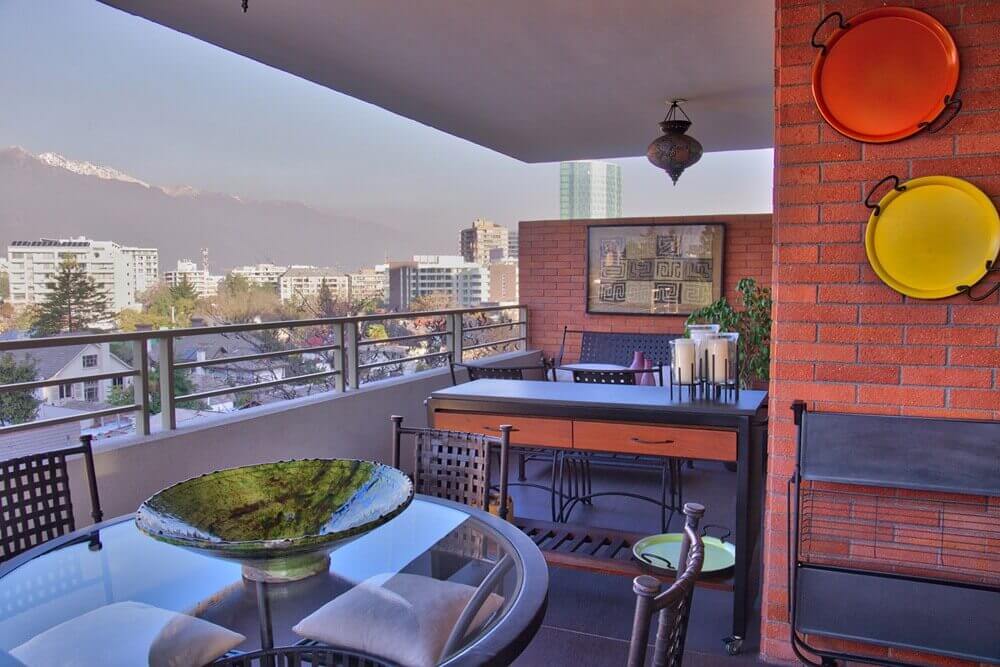 Lovely terrace of an apartment for rent in Las Condes
Security deposit
The standard deposit is one month's rent. Landlords or agents may ask for two months if you are a student or a foreigner with a temporary visa. If someone asks for three months or more, don't sign. If you don't have stable income, you may have serious difficulty getting a standard one-year lease — but you can negotiate directly with a landlord to prepay 3-4 months of rent to give yourself time to get all paperwork done.
Rental contracts
Generally:
- Residential rental contracts have a one-year duration.
- They automatically renew for the same period, unless either party gives formal notice. Usually via a letter signed at a notary, at least 30 days in advance. Some landlords insist on 60 days in the contract, but the law for one-year contracts (or less) requires only 30 days anyway.
- You cannot leave during the contract period, even with prior notice, unless you have a diplomatic clause. Without one, the landlord can require you to pay all remaining months. In practice, the landlord won't sue — what they want is to re-rent quickly — but you can forget your deposit.
- You cannot sublet without the landlord's written agreement.
What to check
Check the payment of condominium fees by the previous tenant, or by the landlord if the property has been vacant. Same for electricity, water, and gas. For condo fees, the landlord can use the previous tenant's deposit. But if utility bills are unpaid, the provider could cut your service.
Agency fees
If you use a real estate agency, you pay 50% of one month's rent plus VAT (19% if the agent is a company, 14.5% if freelance). If your company is paying, ask for a formal invoice (factura) to recover the VAT.
A scam to be aware of
Fake listings exist on Portal Inmobiliario and Yapo.cl. Here's how to spot them:
- A price significantly lower than similar properties in the area. If an apartment is 50% cheaper while the photos show a gorgeous flat, it's suspicious.
- Almost always a listing from an individual, not an agency.
- The landlord cannot be contacted by phone — only by email — because they claim to be living abroad.
- When you send a 2-line inquiry, you receive a perfectly crafted 20-line reply that answers questions you didn't even think to ask.
These fake listings are mostly in areas with limited inventory and high demand — El Golf, Providencia, Santiago Centro. If you suspect something, forward us the email and we'll check. The scam works by asking for a prepayment or deposit via untraceable systems like Western Union or MoneyGram.
A few things to consider
If you arrive from the northern hemisphere, remember that in Chile the sun is to the north at noon. A "north-facing" apartment means a sunny apartment — totally normal.
A limited number of apartments have double-glazed windows or decent insulation. Some have what they call "termopanel." Most don't have central heating, except modern buildings (less than 10 years old). You'll need to buy one or several "estufas" — portable heating units. Three types:
- Paraffin (parafina): the cheapest and most common. Inexpensive to run, but the smell while operating is unpleasant.
- Electric: more expensive, safer if you have children. No ventilation problems. Avoid the cheapest units — they don't actually heat anything.
- Gas: a good compromise — clean, no smell, economical. The unit itself costs more to buy.
If you arrive in spring (October-November) and plan to stay, buy heating units during Black Friday or Cyber Monday sales. Retailers offer 50-60% discounts to avoid carrying inventory through summer.
More Information
Frequently asked questions about finding an apartment in Santiago
Getting Started
For long-term rentals, I recommend arriving first and staying in temporary accommodation for 2-3 weeks. This lets you visit properties in person, discover neighborhoods, and avoid scams. Start your online research before arriving to understand the market, but don't sign anything remotely.
With well-defined criteria and realistic expectations, 2-3 weeks is usually enough. If you work with an agent, a half-day tour of 5-6 preselected properties often does the job. Solo searches take longer, especially for affordable apartments in popular areas where competition is fierce.
March-April has more inventory, as people settle after summer. In tourist areas, furnished properties become available for long-term rental from mid-March when the short-term summer season ends — you can sometimes get good deals on these. Avoid searching in January when everyone is on vacation.
Property Search and Viewings
If your criteria are well defined and your budget is realistic, 5-6 visits are typically enough. I do a preselection phase online with clients before visiting, which eliminates most mismatches. Many clients are surprised that almost all the properties we visit match their criteria — that's the benefit of filtering properly beforehand.
Agents charge 50% of one month's rent plus VAT (19% if the agent is a company, 14.5% if freelance). They save time because they know the area, pre-screen properties, and handle coordination with multiple realtors. If you have limited Spanish, limited time, or are searching from abroad, an agent is worth it. If you have time and speak Spanish, you can search on your own.
Chile is not a bargaining culture — listing prices are close to the real price. A 5-10% discount is typical. For properties above CLP 1,200,000 per month, you have more room because there are fewer qualified tenants. For properties that have been on the market for months, the owner may be more flexible. Don't try to negotiate when you don't yet have the documents to reassure the landlord about your profile.
Documentation and Costs
Ideally: Chilean ID (or passport), employment contract, last 3 salary slips, AFP certificate, and a DICOM credit report. Most foreigners can't provide all of these. The higher the rent, the less strict landlords are about documentation. Having a Chilean guarantor (codeudor solidario) makes a big difference, but most foreigners don't have one — expect to pay extra months of deposit instead.
Pay a higher deposit — 2-3 months instead of one. Having a work contract with a well-known company helps. Some companies will co-sign the lease as your guarantor. For very high-end properties (above USD 2,000/month), landlords are more flexible because they have fewer qualified tenants.
Add 15-25% for gastos comunes (condo fees), utilities, and other expenses. Condo fees alone can be CLP 60,000-250,000 depending on the building size and amenities. Utilities (electricity, gas, water) run around CLP 50,000 each for a couple. Internet is CLP 30,000-40,000. Ask to see the last condo fee bill before signing.
Furnished rental is subject to 19% VAT, making it 25-50% more expensive. For stays under a year, it's usually worth the convenience. For longer stays, renting unfurnished and buying or renting furniture separately is cheaper. You can rent a full set of furniture (beds, sofa, kitchen appliances, everything) for around CLP 300,000-350,000 per month from furniture rental companies.
Contract and Legal
How the rent increases over time (it should follow CPI or UF, not arbitrary percentages), the termination clause (can you leave with 30 days notice at renewal, or are you locked in?), who pays for exceptional condo expenses, and whether there is a diplomatic clause allowing early termination if your visa is rejected or your company transfers you out of Chile.
Most landlords renting to expats accept it. The clause lets you terminate if your company transfers you, dismisses you, or if immigration rejects your visa. It usually activates after 12 months — landlords don't want tenants leaving 3 months in.
If a property is 50% cheaper than similar listings, it's suspicious. If the landlord can only be reached by email because they are "currently abroad," it's almost certainly a scam. If a 2-line inquiry generates a perfectly crafted 20-line reply answering questions you didn't ask, it's a scam. Never pay anything before visiting in person and signing a contract.

Do you want to go more in detail?
I wrote the Chile Handbook for Foreigners for anyone and everyone looking to move permanently and enjoy life in Chile. It's a 265-page book that goes over all aspects of relocating to Chile. Here is what you get:
✅ Practical tips based on 7-year relocation experience
✅ To-do lists to help you start
✅ Last updated in 2025